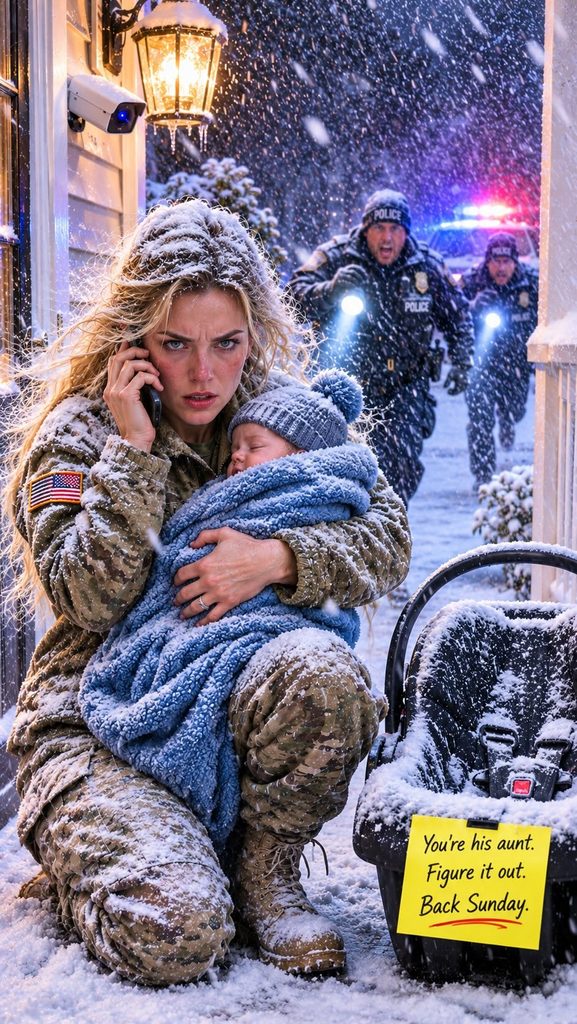
Chapter 1: The Frost on the Threshold
In the military, they teach you that panic is simply undisciplined energy. During my five years as a sergeant in the Army’s military police corps—including two back-to-back rotations through dust-choked logistics corridors in the Middle East—I learned to measure survival in seconds and sightlines. When an alarm sounded at zero-dark-thirty, your boots hit the floor before your conscious mind had even cleared the static of sleep. You checked your weapon, verified your perimeter, and assessed the threat.
I never expected that the most critical triage of my life would occur on a suburban porch in West Des Moines, Iowa, wearing a flannel bathrobe and fleece slippers.
It was Saturday, February 7th. The digital clock on my nightstand read 5:41 a.m. My official alarm was set for 6:30. At 9:55, my flight was scheduled to lift off toward Denver, where my childhood friend Carly was waiting for her maid of honor. In my entryway, my olive-drab duffel and a garment bag holding a plum-colored chiffon dress were already zipped, labeled, and staged by the door.
The doorbell rang once.
It wasn’t the frantic, rhythmic hammering of someone fleeing violence. It was a single, flat, transactional chime.
I lay rigid beneath the duvet, listening through the drafty hush of the house. Outside, an Arctic front had dragged the temperature down to eleven degrees Fahrenheit. With the prairie wind sweeping unobstructed across the frozen cornfields, the wind chill sat at four below zero. At that temperature, exposed flesh freezes in under thirty minutes; an unprotected infant loses core heat in less than ten.
A delivery courier, my drowsy mind offered. Or some neighborhood teenagers running a stupid dawn prank.
I pulled the comforter over my ears, desperate for another forty minutes of rest. But five years in uniform ruins your capacity for willful ignorance. My pulse was already elevated, ticking with that sharp, prickly intuition that used to warn me when a convoy checkpoint was compromised. Something felt profoundly out of sequence.
I swung my legs out of bed. The hardwood floors bit into my soles like sheets of dry ice. I cinched my robe, clicked on the kitchen overhead, and moved to the front picture window. The street was a silent, gray void, illuminated only by the sickly amber sodium glare of the municipal streetlights. Fresh powder was drifting across the asphalt, curling like white smoke. From that angle, the porch floor was obscured by the brick retaining wall.
At 5:49 a.m.—eight minutes after the chime—I pulled back the deadbolt and cracked the front door open.
A gust of sub-zero wind knifed through the opening, cutting straight through my cotton flannel. On the welcome mat, sitting squarely in the drift of dry snow, was an infant car seat—the slate-gray model with navy stars that I had purchased with my own debit card at the Urbandale Target.
Inside it, bundled beneath a thin fleece throw that had begun to stiffen with frost, was my seven-month-old nephew, Luca.
For a second that nearly stopped my heart, the child did not stir. His cheeks were not pink; they were the dull, waxy crimson of raw meat left in a freezer. His lips were parted, rimmed with a faint bluish tint. Then, his small chest hitched. A reedy, gasping shriek tore from his throat—a sound so thin and shredded by the cold that it barely carried over the roar of the Iowa wind.
Beside the plastic base of the carrier sat a canvas diaper bag. Tucked deliberately under the curved plastic lip of the sun canopy, shielded from the gale, was a square of neon-yellow adhesive paper.
The handwriting was unmistakably my sister’s—round, loopy, and entirely devoid of hesitation:
You’re his aunt. Figure it out. Back Sunday.
My training overrode my shock. I didn’t cry out; I didn’t curse. I bent down, hoisted the twenty-pound carrier with both hands, hauled it inside, and slammed the heavy oak door shut with the heel of my bare foot.
“I’ve got you,” I whispered, my voice rattling in my throat as I dropped to the living room rug. “Luca, look at me. Aunt Jamie’s got you.”
I ripped away the stiff fleece blanket. His tiny hands were tucked into fists, his fingers icy to the touch. He wasn’t crying with full lung capacity anymore; he was trembling uncontrollably, emitting tiny, animal whimpers. I stripped off my robe, pulled my thermal undershirt up, and jammed his freezing body directly against my bare ribs, wrapping my flannel over both of us like an emergency field dressing.
The contact made me gasp—it was like pressing two bags of crushed ice against my chest.
With my left hand supporting the back of his shivering skull, I fished my phone from my pocket with my right. I didn’t dial my sister. I didn’t dial our mother. I punched three digits into the keypad, clicked speakerphone, and listened to the electronic pulses connect.
“Polk County 911, what is the address of your emergency?”
“This is Jamie Given,” I said, my voice dropping into the flat, unhurried cadence of an incident report. “I am a veteran and a claims investigator at 1412 Maplecrest Drive. I have an abandoned seven-month-old infant exhibiting early-stage hypothermia. Ambient exterior temperature is eleven degrees. Dispatch EMS and patrol units immediately.”
As the operator acknowledged the call, my eyes drifted toward the small, blinking blue LED on my front hallway wall—the hub of the high-definition security camera mounted directly above my doorbell.