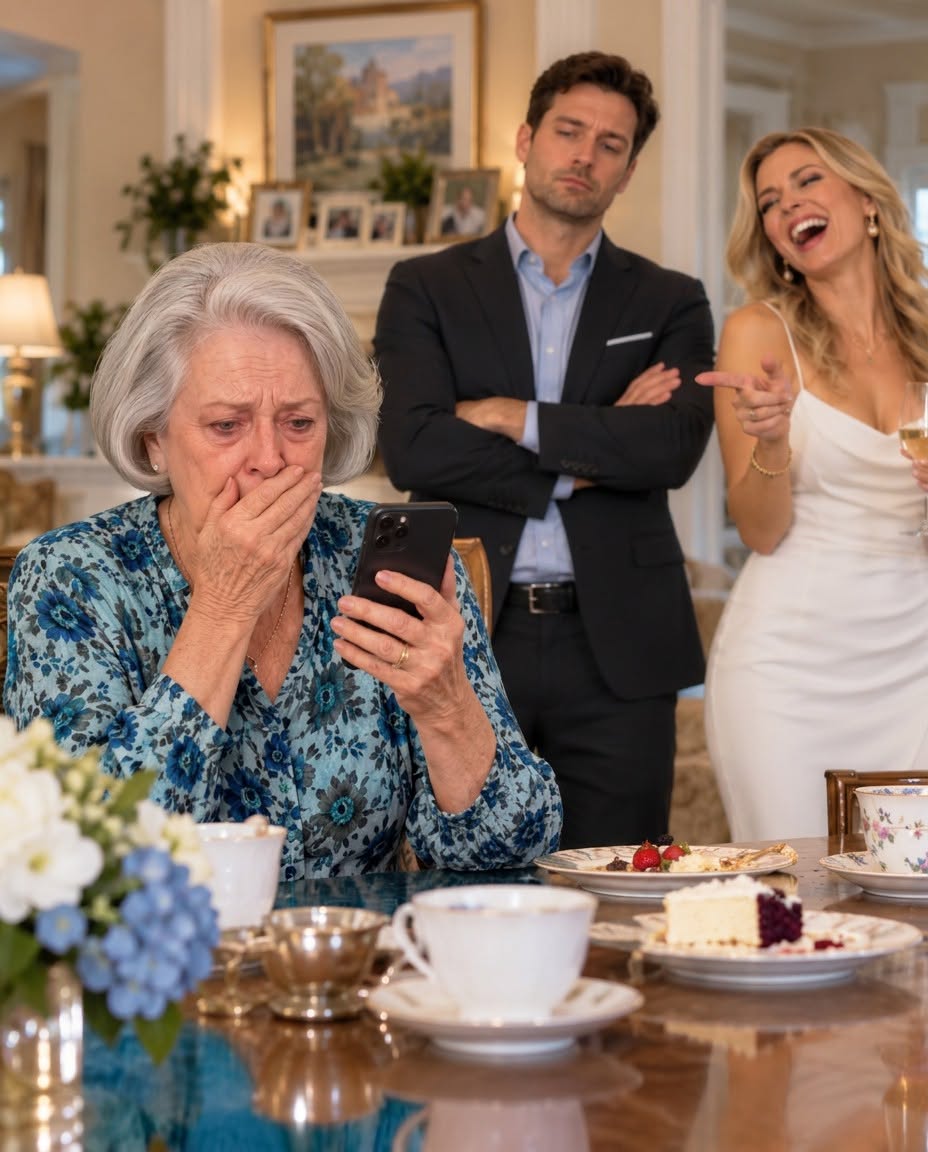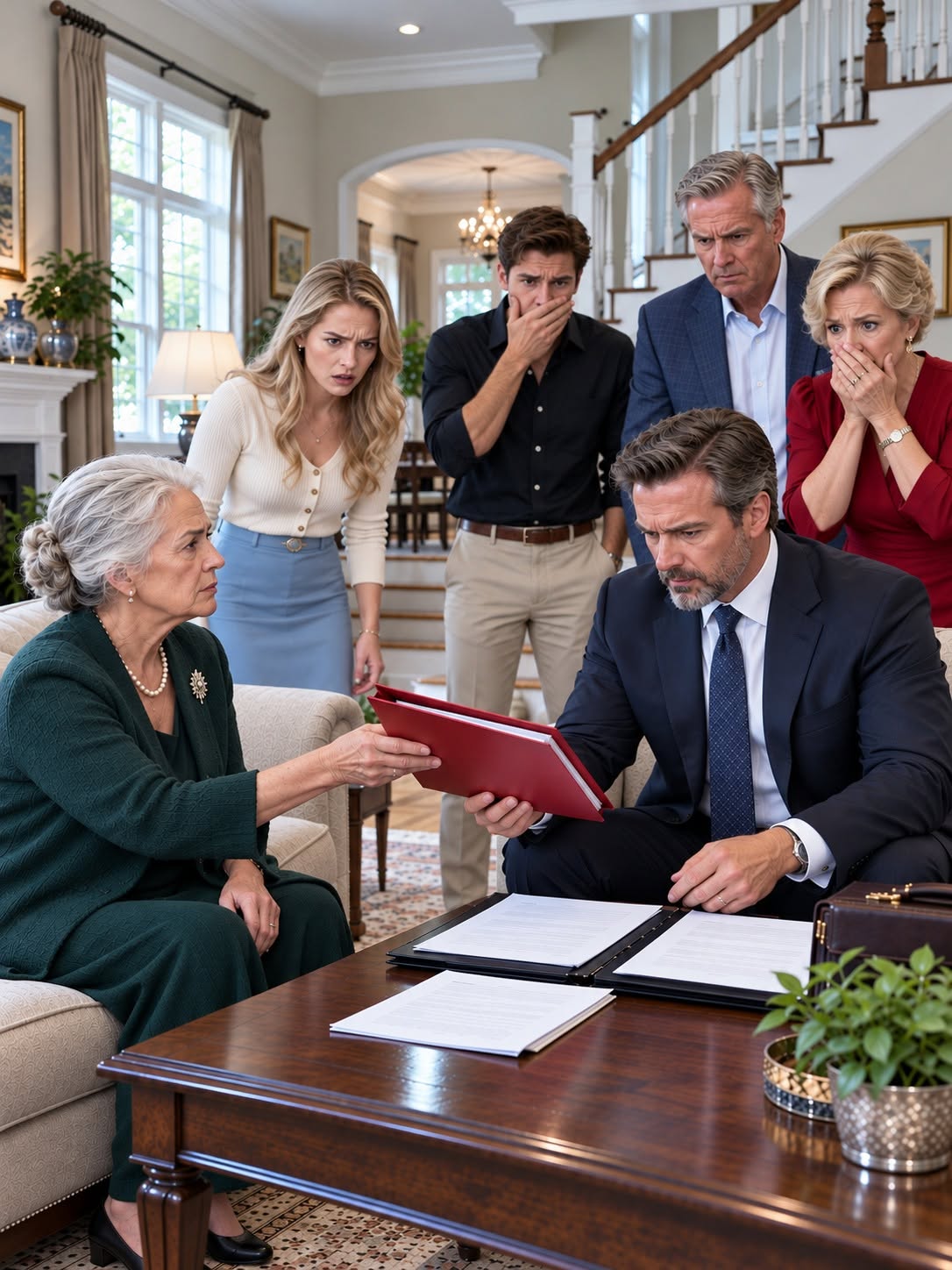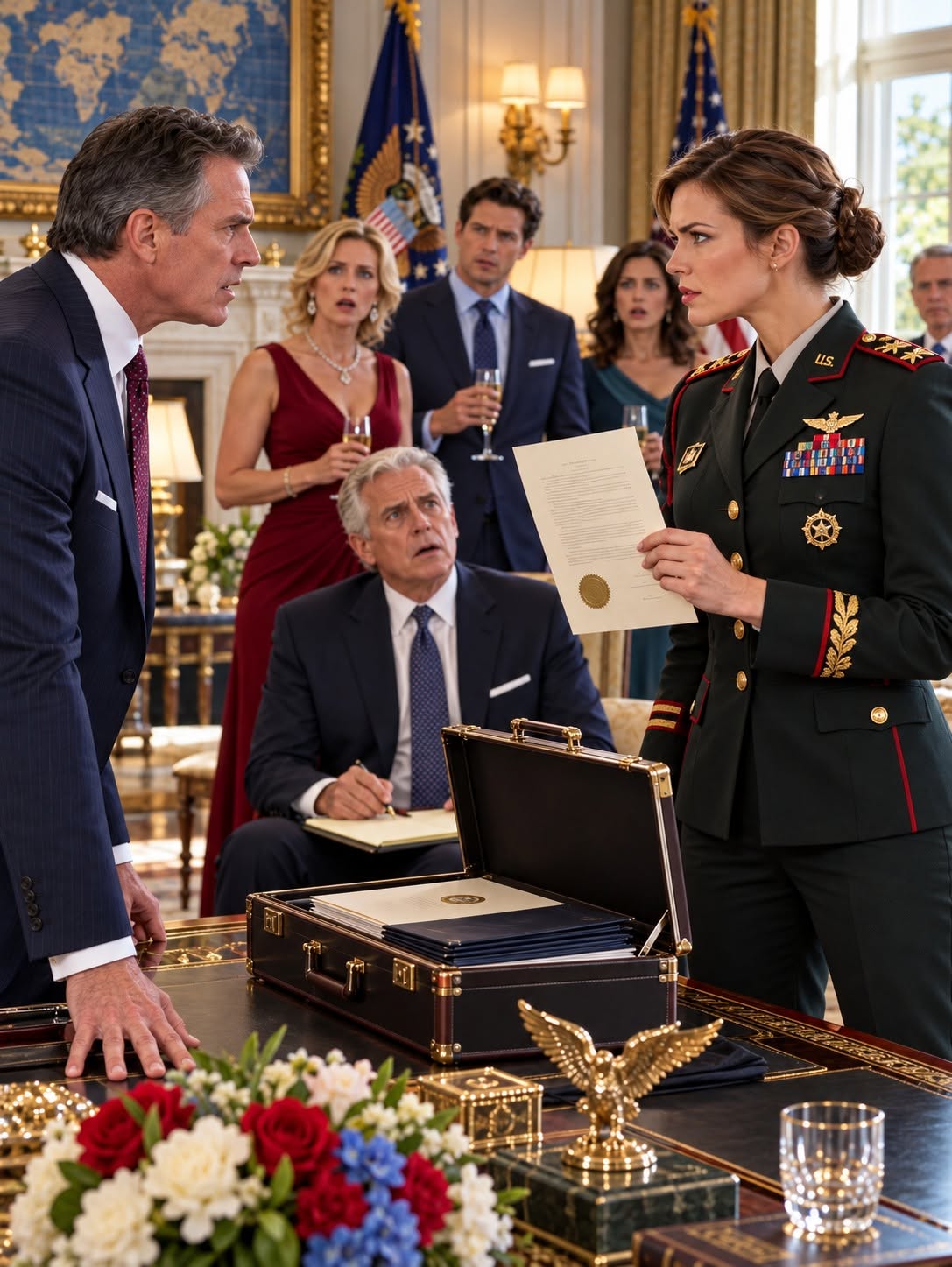
At the reading of the will, my father proudly announced, “The three San Diego houses are going to my son. She gets absolutely nothing.”
The entire room burst into applause.
I simply smiled, turned toward the attorney, and asked, “He still hasn’t seen it, has he?”
The lawyer’s expression suddenly collapsed.
My father shouted, “Seen what?!”
The atmosphere inside the Matthews estate in Pacific Beach was heavy and almost impossible to breathe in. The air carried the overpowering combination of warm shrimp cocktail and inexpensive Chardonnay served in costly crystal glasses. Thirty people had gathered, most of them Ryan’s drinking companions and my father’s longtime business contacts, turning Grandma Margaret’s wake into something that looked more like a business networking event.
No one spoke about her.
Not one person offered a cherished memory of the woman who had created our family’s wealth with nothing more than a single delivery truck. Instead, conversations revolved around real estate valuations, investment opportunities, and capital gains taxes. Listening to them, you might have thought the woman we had buried that day was nothing but an inconvenient obstacle in a financial deal.
I sat quietly among the guests, dressed in my Navy service dress blues. The dark uniform stood out sharply against the soft pastel colors everyone else was wearing.
On the opposite side of the room, Ryan sprawled comfortably with his feet resting on the mahogany coffee table. One arm was wrapped around Brooke, whose long acrylic fingernails curved like a bird of prey’s claws. She tapped those nails against her wineglass while laughing at something he had whispered.
“Just wait until next week, babe,” Ryan said, deliberately speaking loudly enough for nearby guests to overhear. “That Porsche 911 will be parked right in our garage.”
Nobody even attempted to conceal their greed anymore.
It was shameless, repulsive, and seemed to consume every bit of oxygen in the room.
Then my father, Thomas Matthews, straightened his tie and stood in the middle of the gathering, rising to his full height like a monarch preparing to address his loyal subjects.
He never looked directly at me.
His eyes passed over my head as if I were nothing more than an irrelevant piece of furniture.
“Ryan is my firstborn,” he proclaimed, his voice filled with the artificial authority he had always confused with genuine leadership. “He needs a strong foundation so he can start a family. He’s the one who carries the Matthews name.”
He stopped speaking for a moment, enjoying the suspense before driving the knife deeper into the wound he had already created.
“And Olivia,” he went on, waving vaguely toward where I sat, “made her own decision to abandon this family and play soldier. She’s got a pension. She’s got medical insurance. She’s got that GI Bill business. Uncle Sam has already provided for her. So your grandmother’s legacy belongs to the person who truly needs it. Ryan.”
Applause exploded throughout the living room.
They were clapping because I had been stripped of an inheritance.
They were enthusiastically endorsing the warped belief that my military service, the sacrifices I had made, and the independence I had fought to achieve were exactly why I ought to be penalized.
Every difficulty I had overcome, every sleepless night, every assignment that had taken me thousands of miles away from home had somehow become proof that I required nothing and deserved even less.
I slowly turned toward my mother, searching her expression for even the faintest indication that she recognized the injustice.
Susan Matthews lowered her gaze, anxiously twisting the imitation pearl necklace around her throat.
When she eventually looked back at me, her face offered no apology.
She crossed the room with uncertain steps and placed her cold palm on my shoulder. Bending close enough to create the appearance of comforting me, she whispered at a volume that allowed the closest guests to hear.
She was performing her usual part as the woman supposedly responsible for keeping our family together.
“Olivia, please don’t cause a scene,” she murmured. “Your brother is sensitive. You’re the strong one, remember? You’ve always managed to survive. You don’t need those old properties. Just let him have them so everyone in this family can finally have peace.”
Again, she was turning my ability to endure hardship into a weapon against me.
In my mother’s mind, because I rarely cried, I apparently had no capacity to suffer.
She expected me to surrender yet another piece of myself to nourish her pampered golden child, simply because I had already proven I could tolerate being hurt.
“Thanks, Dad! Thank you, Mom!” Ryan yelled, springing upright. “I swear I’m going to make this family proud!”
His cheeks glowed with alcohol and self-importance.
He raised his drink in my direction, a mocking grin spreading across his face.
“Cheer up, soldier girl,” he taunted. “If that government paycheck ever leaves you struggling, maybe I’ll loan you a couple thousand bucks. Just don’t forget that I collect interest.”
Brooke erupted into a shrill laugh that felt like it was scraping against my nerves.
The humiliation was absolute.
They had belittled everything I had achieved, dismissed my existence as insignificant, and were practically celebrating over the remains of whatever loyalty I had once felt toward this family.
Beneath the table, I could feel the reassuring solidity of my Halliburton aluminum briefcase against my combat boot.
Inside it lay eight property deeds, each stamped with an official red seal, properly signed and notarized three years before that afternoon.
I shut my eyes for the briefest moment.
Breathe in for four counts.
Hold for four.
Breathe out for four.
Hold for four.
The box-breathing method practiced by Navy SEALs took control, reducing my pounding heartbeat until it settled into a steady, controlled rhythm.
My rage hadn’t disappeared.
Its temperature had simply changed.
Now it was cold, concentrated, and exact.
It no longer threatened to sweep me away.
It had become ammunition.
I didn’t leap from my chair and start shouting.
I didn’t hurl a glass across the room or demand an apology from my father.
Instead, I looked past him, past Ryan, and directed my attention toward our family’s attorney, Mr. Hollis, who was already preparing his pen to complete the documentation.
When I finally spoke, my words sliced through the celebration like a sharpened blade.
“Mr. Hollis,” I said calmly, with almost no emotion in my voice, “before you allow anyone to sign those documents, are you completely sure your records were updated after May 2021?”
To understand why I remained so calm instead of screaming at the attorney or throwing my drink in Ryan’s face, you need to travel fifteen years into the past.
You need to sit with me at the Matthews family dinner table and experience the peculiar silence that was reserved for me alone.
I can still remember the scent of hickory-smoked barbecue ribs and the sound of ESPN roaring from the television in the adjoining room.
Dad occupied the head of the table, holding his fork as if it were a king’s scepter. He distributed his attention as though love were a scarce form of currency that needed to be invested only where it would produce the best return.
“Ryan, tell me about that touchdown you threw in the second quarter,” he said, his eyes glowing with pride in an accomplishment that wasn’t his.
Ryan shrugged with carefully rehearsed indifference, his mouth stuffed with cornbread.
“Coach picked the wrong play. Honestly, if the offensive line hadn’t been dragging their feet, I’d have scored three more. But yeah, that throw was pretty elite.”
Dad nodded with exaggerated wisdom.
Immediately, the two of them began complaining about the coach, the blockers, and the officials.
Somehow, despite Ryan’s varsity football team having lost 14–35, the only person who bore no responsibility was Ryan.
In my father’s universe, Ryan could never truly lose.
Other people simply failed him.
At the opposite end of the table, I silently placed a sheet of paper on the tablecloth.
It was my report card for the semester.
Every grade was an A.
Calculus: A-plus.
Physics: A.
I carefully flattened the paper’s corners and waited.
I waited for the conversation about football to pause.
I waited for somebody to glance toward the paper.
I waited for the possibility that my father might acknowledge what I had accomplished.
The report card sat between the bowl of coleslaw and the stack of napkins, a little white rectangle nobody seemed remotely interested in reading.
Five minutes went by.
Then another five.
Eventually, Dad turned his head toward me.
“Olivia,” he grunted, gesturing with his knife toward the empty serving dish, “we’re out of ribs. Go see if there’s more in the kitchen, and take these dishes while you’re at it.”
He hadn’t noticed my grades.
Or maybe he had seen the report card and consciously decided it wasn’t worth acknowledging.
I wasn’t someone worthy of praise.
I was unpaid household help, the daughter nobody noticed, expected to wash dishes while the important members of the family celebrated their achievements and talked about the future of their legacy.
By the time I reached my junior year of high school, that invisible separation had grown into a vast canyon.
It was homecoming week, and Ryan, who was a senior, had decided he needed an entirely new appearance to impress the girls on the cheerleading squad.
From the doorway of my parents’ bedroom, I watched Mom sitting at the edge of their bed with her checkbook open.
Ryan stood before them holding a garment bag containing an expensive Italian wool suit.
“Eight hundred dollars, Susan?” Dad asked, arching one eyebrow, even as his hand moved toward his wallet.
“He has to look the part, Tom,” Mom replied, beaming fondly at her favorite child. “We’re investing in his self-confidence.”
Without another moment of hesitation, she ran the credit card.
Eight hundred dollars for a single evening of dancing and punch that somebody would probably spike with alcohol.
Nobody lectured Ryan about being financially responsible.
Nobody mentioned the family’s monthly expenses.
Nobody suggested purchasing a less costly suit.
A few days later, I approached my mother while she was working in the kitchen.
I had spent weeks researching universities, dreaming of attending an Ivy League institution or the Naval Academy.
My academic record was excellent, but I wanted higher standardized test scores. I had discovered a collection of advanced SAT preparation books that I thought could make a meaningful difference.
“Mom,” I said softly, “I need some advanced SAT study books. The complete set costs fifty dollars.”
She let out a prolonged, theatrical sigh, as if my question had instantly exhausted whatever patience she possessed.
The expression she gave me suggested I had requested one of her kidneys.
“Seriously, Olivia,” she snapped, abruptly scrubbing a saucepan with unnecessary force. “Money’s a little tight right now. Why can’t you check them out from the library? Why do you always have to ask for so much? You really need to stop being so selfish.”
Selfish.
That word seemed to hang in the space separating us.
Spending eight hundred dollars on a suit Ryan would probably throw up on was apparently an investment in his confidence.
Spending fifty dollars on books that might influence my entire educational future was selfish.
That afternoon, while Ryan drove off in Dad’s brand-new Ford Mustang to collect his date, I dressed myself in a secondhand outfit that had belonged to my cousin.
The dress was two sizes too large, dangling awkwardly from my shoulders.
As I stood before my mirror, tugging at fabric that would never properly fit, I finally understood the system of accounting that controlled our household.
Ryan was considered an asset.
I was considered a liability.
The ultimate separation happened three years afterward.
I came home with my heartbeat pounding against my chest, holding a thick envelope that represented years of effort, dedication, and personal sacrifice.
“I got accepted,” I announced, setting the letter confirming my admission to the Navy’s Officer Candidate School on the living room coffee table.
Dad glanced at the document while the television was showing commercials.
“The Navy, huh? That’s good, I guess. At least I won’t have to pay for college.”
He immediately returned his attention to the screen.
“Actually, Olivia, it’s probably a good fit for you. The military’s got plenty of structure. You won’t need to worry about being too feminine. All you have to do is obey orders.”
He didn’t congratulate me.
He didn’t hug me.
He certainly didn’t say he was proud.
All I received was an expression of relief that I would no longer be a financial burden, followed by an insulting observation about my femininity.
When the time arrived for me to leave for Newport, Rhode Island, I packed everything into one duffel bag.
I waited in the foyer, clinging to the small hope that one of my parents might offer to take me to the bus station.
“Sorry, sweetheart, I can’t drive you,” Mom shouted from upstairs. “Ryan chipped his tooth trying to open a beer bottle. I’ve got to take him to the dentist.”
“And my tee time’s at ten,” Dad added, glancing at his wristwatch. “You can get an Uber, can’t you? You’re independent.”
So I boarded a Greyhound bus.
When the massive diesel engine rumbled awake and the vehicle began moving away from the curb, I stared through the window at the deserted sidewalk.
Nobody had come to say goodbye.
There wasn’t a single person waving as I left.
That was when it finally struck me that I wasn’t truly leaving a family behind.
Because in all the ways that actually mattered, I had never really possessed one.
Newport was bitterly cold, damp, and thoroughly miserable.
They called the ordeal Hell Week with good reason.
I crawled through icy mud while my lungs felt as though they were on fire. A drill instructor screamed only inches from my face, attacking my weakness, criticizing my form, and seemingly condemning my entire existence.
Yet, for the first time I could remember, I experienced something that resembled peace.
That may sound ridiculous, even completely irrational.
But it was true.
When the instructor shouted at me, he wasn’t doing it because I was Olivia, the daughter nobody valued.
He was correcting me because I wasn’t performing a push-up properly.
The criticism was based on something concrete.
The requirements were unmistakable, and every candidate had to satisfy the same standards.
It was fair.
During an inspection one morning, the instructor stopped alongside my bunk.
He pulled a quarter from his pocket and dropped it onto my precisely made bed.
The coin bounced upward.
He checked the edges of the sheets and discovered perfectly folded forty-five-degree corners.
Then he stared directly into my eyes.
“Outstanding, candidate.”
One word.
That one word satisfied a hunger I hadn’t even understood I was carrying.
I adopted the creed associated with Jocko Willink: Discipline equals freedom.
The military hadn’t destroyed me.
It had shaped me into something stronger.
It taught me that love wasn’t a limited resource I had to plead for while sitting at a family dinner table.
It showed me that authentic respect came from actions, not the privileges of being somebody’s favorite.
Every morning when I made my bunk, I felt as though I were adding another brick to the barrier between myself and those who had spent years making me feel insignificant.
I grew tougher.
More focused.
More disciplined.
Under the pressure of training and purpose, I became a weapon.
And weapons don’t break down crying because somebody excludes them from an inheritance.
They reload.
The story isn’t over yet. Select “Next Part” below to see what happens next.