The Blueprint of a Mother’s Mercy
Chapter 1: The Fracture in the Plumb Line
My name is Mara Ellison. I am thirty-six years old, and until the rainy Tuesday afternoon when my daughter was wheeled into trauma surgery, I harbored the childish conviction that the worst thing my mother could do was make me feel small.
I was wrong. Some people do not merely diminish you; they will dismantle your entire world to protect the wallpaper of their own vanity.
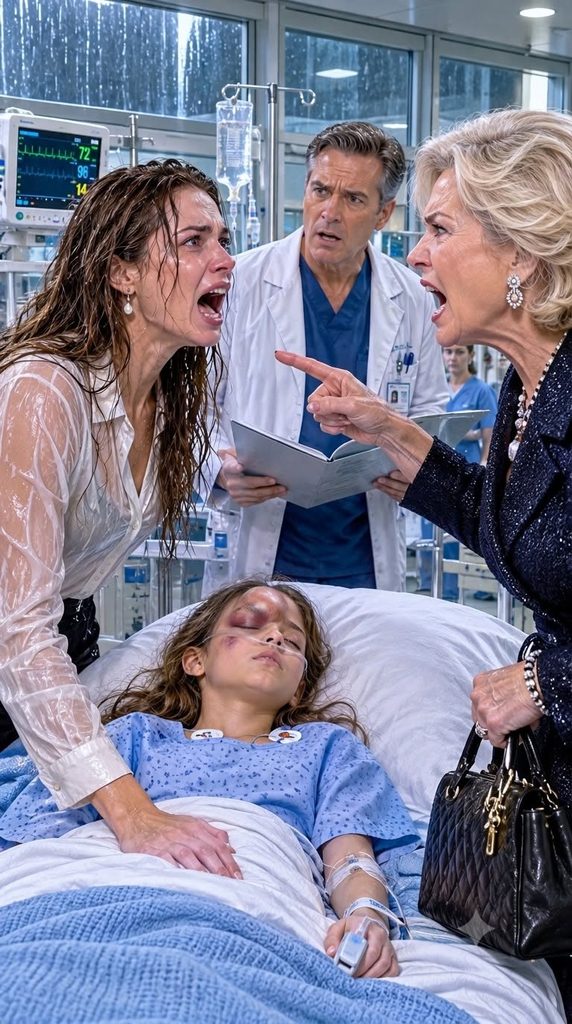
I was driving down Route 9 toward Belle Haven Regional Hospital, wipers slapping a greasy rhythm across the glass, when the hands-free console chimed. The voice that came through the speakers was clipped, level, and wrapped in the sterile precision of an emergency room. He introduced himself as Dr. Daniel Reyes, chief neurosurgeon on duty. He told me that my eleven-year-old daughter, Lucy, was in a profound coma, presenting with acute epidural hematoma—massive hemorrhaging within the cranium. His team was prepping an emergent craniotomy to relieve intracranial pressure.
The steering wheel felt like dry chalk under my palms. My right foot went numb against the floorboard, losing all contact with the pedal. I swung wildly into the gravel apron of an abandoned farm supply depot, the tires spitting loose stone, until the engine shuddered to an idle beneath a rusted sheet-metal awning.
“Is she going to survive?” I rasped. My voice sounded thin, like dry paper torn down the seam.
Dr. Reyes was not the sort of surgeon who offered narcotics in the form of false assurances. “She is in critical status, Mrs. Ellison. The next few hours will determine everything. But before I take her in, I need an immediate administrative clarification. Are you Lucy Ellison’s sole custodial parent and legal guardian?”
“Yes. Yes, of course I am. I’m her mother.”
“Is there any court order, healthcare directive, or proxy giving anyone else legal authority to make clinical decisions on her behalf?”
“No,” I stammered, my chest seizing around an icy vacuum. “No, nobody. Why on earth are you asking me that right now?”
A heavy pause settled over the line. It was not the hesitation of a physician struggling to deliver a terminal prognosis; it was the calculated calibration of a professional deciding how to frame a monstrous reality.
“Your mother, Evelyn Mercer, is here,” Dr. Reyes stated, his cadence deliberate and flat. “She arrived ahead of the pediatric transport unit. She identified herself to admissions and clinical staff as the head of the household and sole authorized guardian. When my team initiated prep for surgical decompression, she instructed us to cease all interventions immediately.”
I gripped the dashboard with my fingernails. “She… what? She must not understand. She gets terrified by paperwork, she panics over bills—”
“Mrs. Ellison, please listen to the exact wording documented in her chart,” Reyes interrupted gently, but with steel underneath. “‘Do not operate. Let her die. We aren’t paying for this.’ Those were her spoken instructions to our trauma team.”
The air evacuated my lungs. Outside, rain pounded against the tin roof of the abandoned store, a deafening drumbeat that seemed to vibrate directly against the base of my skull.
Let her die.
My mother had raged over money my whole life. She scrutinized utility statements with a magnifying glass, interrogated mechanics over five-dollar gaskets, and perpetually reminded the county that she was the only pillar of fiscal rectitude keeping our family from ruin. But Lucy was her only grandchild. Lucy was the little girl who picked out the burnt marshmallows from the campfire hot cocoa because Grandma prefers the crisp ones. Lucy was the girl my mother paraded through church socials as her little apprentice.
“I need you to hear me clearly,” Dr. Reyes continued, his voice piercing through the roaring in my ears. “Emergency life-saving care for a minor is not withheld on the say-so of a non-custodial relative. Our neurosurgical team has already initiated pre-op stabilization. But I must have your verbal consent on the medical record now, and I need you on-site.”
“Yes! Operate! Do whatever it takes, give her everything!” I sobbed into the steering wheel, pressing the heels of my hands against my eyes. “Please… don’t let her go. Please don’t let her slip away.”
“We are proceeding. Now drive safely, Mrs. Ellison. But there is a secondary discrepancy you must prepare for.”
I choked back a breath. “What else? Tell me.”
“When your mother checked Lucy into intake, she documented the mechanism of injury as a simple slip and fall in the domestic kitchen—at her personal residence on Maple Street.”
“Yes,” I answered blankly. “That’s what she texted me an hour ago. She said Lucy slipped on wet linoleum.”
“The ambulance was not dispatched to Maple Street,” Dr. Reyes said quietly. “The paramedic intake report indicates the extraction occurred at Mercer Upholstery and Storage, back warehouse bay three, below an elevated timber platform. The paramedic crew noted immediate structural collapse of a loft railing. The state troopers and local safety inspectors are already en route to that facility.”
The phone slid from my clammy fingers and bounced onto the passenger floor mat, landing beside a folded sheet of sketch paper Lucy had wedged into the console that very morning.
My mother had not simply tried to deny my daughter life-saving surgery. She had spent the last two hours constructing a fortress of fabrications while my eleven-year-old child lay bleeding out into the dark.